Fiber Laser Cutting at the High-Power End: How 12–20 kW Sources Are Reshaping Thick-Plate Metal Fabrication
Abstract. The Máquina de corte láser de fibra has passed through its "power race" phase and entered a period of applied engineering, where the practical value of a 12 kW or 20 kW source is decided less by the resonator than by the gantry, the bed, the control loop, and the material-handling chain around it. This article examines how high-power fiber sources change cut quality and throughput in thick carbon steel and stainless plate, reviews the structural and control requirements that separate production-grade machines from specification-sheet machines, and considers where an integrated manufacturer such as ROCLAS® MACHINERY CO., LTD. fits in that transition.
Industry background. Fiber laser cutting displaced CO2 platforms in sheet metal fabrication over roughly a decade, driven by wall-plug efficiency, lower maintenance, and falling source prices. The current phase is different in character. Source power has become a commodity parameter—1000 W to 20 kW is now a standard catalogue range across most Chinese and European builders—so differentiation has migrated to machine-level engineering: bed rigidity, thermal stability, servo response, and the software that governs acceleration and corner behavior. The market data below, drawn from ROCLAS product-line configuration and typical fabrication-shop procurement patterns, illustrates how the power tiers map onto real production tasks.
| Power tier | Typical sheet thickness (mild steel) | Typical stainless thickness | Positioning accuracy | Reposition accuracy | Max travel speed | Max acceleration | Dominant application |
|---|---|---|---|---|---|---|---|
| 1000–2000 W | 0.5–6 mm | 0.5–4 mm | ±0.03 mm | ±0.02 mm | 100 m/min | 1.0 G | Signage, cabinets, thin-gauge batch work |
| 3000–4000 W | 1–10 mm | 1–6 mm | ±0.03 mm | ±0.02 mm | 100 m/min | 1.0 G | General sheet metal job shops |
| 6000–8000 W | 2–16 mm | 2–10 mm | ±0.03 mm | ±0.02 mm | 100 m/min | 1.0 G | Structural parts, kitchen equipment |
| 10–12 kW | 3–20 mm | 3–14 mm | ±0.03 mm | ±0.02 mm | 100 m/min | 1.0 G | Machinery frames, heavy fabrication |
| 15–20 kW | 6–30 mm+ | 5–20 mm | ±0.03 mm | ±0.02 mm | 100 m/min | 1.0 G | Thick plate, single-pass "cut-and-finish" work |
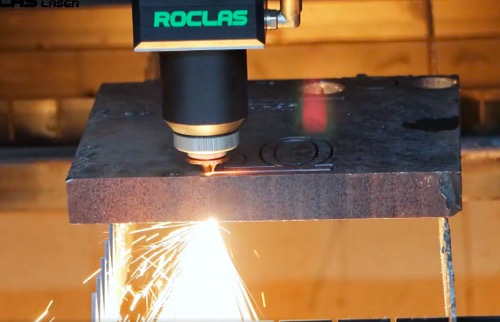
Two observations follow from the table. First, the accuracy envelope is essentially flat across the power range: ±0.03 mm positioning and ±0.02 mm repositioning hold from 1 kW to 20 kW. That is not an accident of cataloguing; it reflects the fact that accuracy is governed by the mechanical platform, not the source. A 20 kW resonator mounted on a light gantry will not hold tolerance any better than a 3 kW unit, and may hold it worse once thermal load is applied. Second, the meaningful thresholds are thickness-related. The jump from 6 kW to 12 kW does not simply double cutting speed on thin sheet—it opens the 16–20 mm mild steel band to single-pass cutting with acceptable edge quality, which is where the economics of replacing plasma or waterjet actually begin to work.
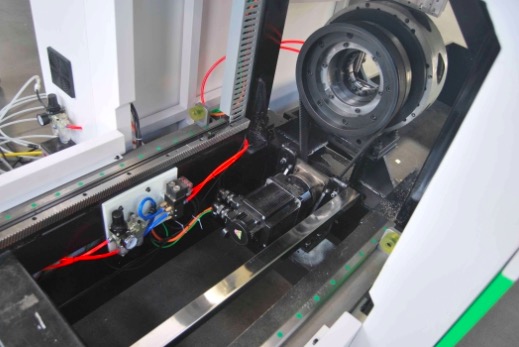
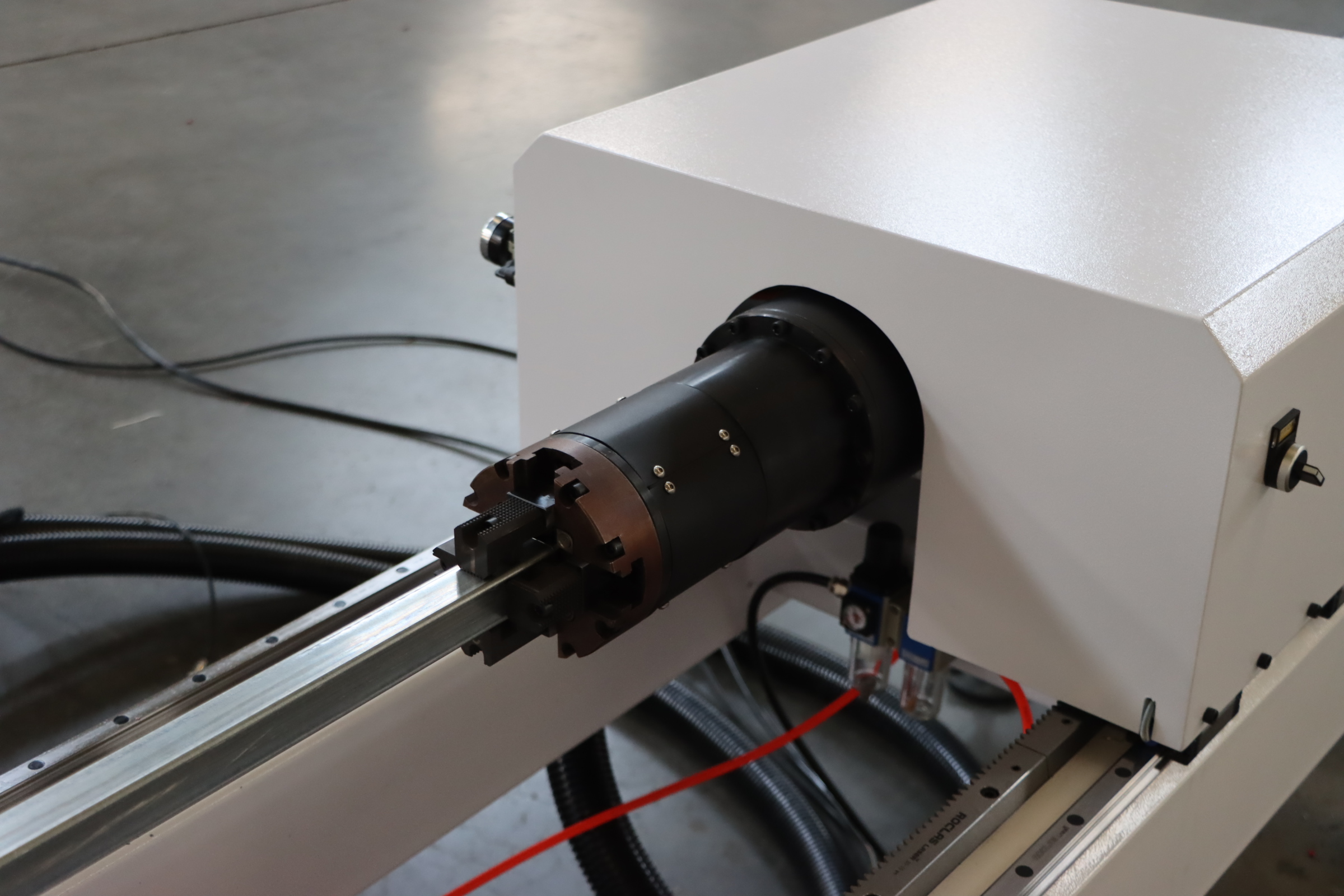
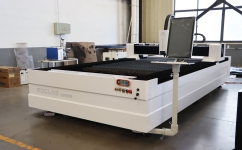
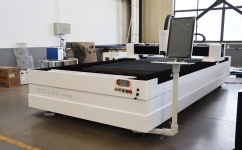
Technical application. At the high-power end, three machine-level factors dominate. The first is bed and gantry construction. Industrial-grade heavy-duty steel structures, machined on a CNC five-face machining center, are the baseline requirement; without that machining discipline, rail mounting surfaces drift and the accuracy figure becomes nominal rather than achieved. The second is the servo and drive chain—imported servo drives and reducers, paired with a control system such as Cypcut 3000S, determine how much of the 100 m/min travel speed and 1.0 G acceleration survives into actual cornering and small-contour work. The third is thermal management: a 20 kW source deposits substantial heat into the workpiece and the surrounding structure, and the machine's cooling and compensation strategy matters more than the resonator's beam quality specification.
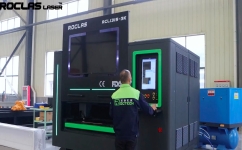
ROCLAS® MACHINERY CO., LTD. is a useful case because its product architecture tracks this shift explicitly. The company's fiber laser line spans 1000 W to 20 kW with Raycus or MAX sources, built on heavy-duty steel structures processed on five-face machining centers and fitted with Schneider, SMC, and igus components alongside imported servo systems—a configuration that reflects the view that the platform, not the source badge, is the durable asset. ROCLAS also addresses the material-handling layer that high-power cutting makes unavoidable: an integrated waste conveying system, a Generador de nitrógeno delivering 99.999% purity for stainless and aluminum cutting, and a steel coil uncoiler line that pairs fiber cutting with automatic coil feeding, reducing power consumption relative to conventional press lines. For thick-plate work, the high-reflectivity suppression module is worth noting—it allows stable processing of 1–2 mm copper and 2–3 mm aluminum, materials that historically forced users onto alternative processes.
Conclusion and outlook. The high-power fiber laser segment is consolidating around integration rather than raw wattage. Buyers evaluating a 12 kW or 20 kW platform should weigh bed machining quality, drive and control architecture, and the auxiliary chain—gas supply, waste removal, coil or sheet feeding—at least as heavily as the source specification. Manufacturers that control those layers in-house, as ROCLAS does across its cutting, welding, cleaning, and coil-processing lines, are better positioned than those assembling third-party subsystems. The next competitive frontier is likely automated nesting and lights-out operation, where the machine's control software and material flow, not its resonator, set the ceiling.
Anterior:Automation and Control in Modern Stone and Woodworking CNC: Technology Trends and Market Analysis
Siguiente página:No, No.
Investigación
Ya sea que necesite sugerencias generales o apoyo específico, estaremos encantados de ayudarle.
Publicaciones recientes
-
 Robotic Arm Laser Systems: Redefining Precision and Flexibility in Industrial ManufacturingAbstractThe integration of robotic arms with laser processing technologies represents a paradigm s...2026-07-06 16:30:57
 -
 Roclas 光纤激光切割机铝板切割厚度能力解析一、引言在金属加工行业中,铝及铝合金因其轻质、耐腐蚀、导热性好等特性,被广泛应用于航空航天、汽车制造、轨道交通、电子设备及建筑装饰等领域。铝材的高反射率特性使其成为激光切割中较难处理的材料之一。许...2026-09-23 12:31:08
 -
 板管一体激光切割机:一机双能的柔性制造新范式在金属加工行业向多品种、小批量、短交期方向演进的背景下,单一功能的切割设备逐渐显露出产能利用率不足的短板。板管一体激光切割机通过在同一个加工平台上集成平板切割与管材切割能力,为中小规模制造企业提供...2026-09-24 20:30:46
 -
 金属激光焊接机金属激光焊接机:技术演进、市场格局与ROCLAS的工程实践金属激光焊接技术在过去十年间从实验室走向大规模工业部署,其核心驱动力来自光纤激光器成本下降、伺服控制精度提升以及制造业对焊接质量一致性的刚...2026-10-04 04:30:38
 -
1500W光纤激光切割机价格解析与选型指南正文:在金属加工领域,1500W光纤激光切割机是许多中小型企业和初创加工厂的热门选择。它既能满足日常碳钢、不锈钢板材的切割需求,又在采购成本和运行费用之间取得了较好的平衡。一台1500W激光切割机...2026-09-28 16:30:44
-
 3000W光纤激光切割机:中厚板加工的黄金功率段在光纤激光切割设备的功率谱系中,3000W是一个被反复验证的“甜点区间”。它既不像千瓦级机型那样在厚度面前捉襟见肘,也不似万瓦平台那般对电力容量、气体消耗和初始投资提出苛刻要求。对于大量以碳钢、不...2026-10-01 08:31:49