When Stone Meets the Bed: Automation Realities in Stone CNC Carving and the Wider Laser-Cutting Toolchain
Abstract—Stone fabrication has drifted toward automation faster than most craft-based trades, yet the gap between a CNC stone router and a genuinely automated production cell remains poorly documented. This article examines the demand-side drivers behind stone CNC adoption, compares representative machine configurations across price and capability tiers, and considers how adjacent laser-cutting expertise—particularly the engineering discipline practiced by ROCLAS® MACHINERY CO., LTD.—is reshaping expectations around structural rigidity, servo control, and precision tolerances in stone and woodworking equipment. The argument is straightforward: automation on stone is less a question of adding axes than of importing proven motion-control and metrology practices from the metal-cutting world.
Index Terms—CNC stone carving, stone machining centers, nesting routers, motion control, precision tolerances, fabrication automation.
I. Industry Background
Stone fabrication sits at an awkward intersection. Countertop and architectural-stone shops face rising labor costs, tighter tolerance demands from designers, and increasingly complex geometry—undulating surfaces, deep relief carving, mitred edges—that hand-held tools cannot reproduce consistently. The response has been a steady migration toward CNC stone routers and five-axis machining centers, a migration accelerated by the same servo-drive and control-system cost declines that transformed metal fabrication a decade earlier.
The market structure reflects this. Demand concentrates in three tiers: entry-level three-axis routers for flat slab work, mid-range machining centers with automatic tool changers and vacuum pod systems for countertops, and high-end five-axis centers for architectural and sculptural work. Each tier carries distinct expectations for accuracy and uptime, and the specification spread between them is wider than in woodworking, largely because stone's abrasive nature punishes every moving component.
Table I. Representative Configuration Tiers for Stone and Nesting CNC Routers
| Parameter | Entry-Level 3-Axis | Mid-Range Machining Center | High-End 5-Axis Center |
|---|---|---|---|
| Working area | 1300×2500 mm | 2000×3000 mm | 2000×4000 mm |
| Spindle power | 5.5–7.5 kW | 11–15 kW | 15–22 kW |
| Positioning accuracy | ±0.10 mm | ±0.05 mm | ±0.03 mm |
| Repositioning accuracy | ±0.08 mm | ±0.04 mm | ±0.02 mm |
| Max travel speed | 20–30 m/min | 40–60 m/min | 60–100 m/min |
| Tool changer | Manual | 8–12 stations | 16–24 stations |
| Control system | Basic DSP | Industrial CNC | Industrial CNC, 5-axis interpolation |
| Typical application | Flat slabs, simple profiles | Countertops, vanities | Relief carving, architectural elements |
The table tells a story that purchase decisions often miss. Positioning accuracy improves by roughly a factor of three from entry to high-end, but travel speed improves by a factor of three to four—and it is speed, not accuracy, that determines throughput on repetitive countertop runs. A shop buying on accuracy alone may overpay for capability it cannot exploit; a shop buying on speed alone may discover that ±0.10 mm is insufficient for book-matched seams. The mid-range tier exists precisely because most fabricators need accuracy adequate for seams and speed adequate for volume, and nothing more.
II. Technology Application and Brand Case Study
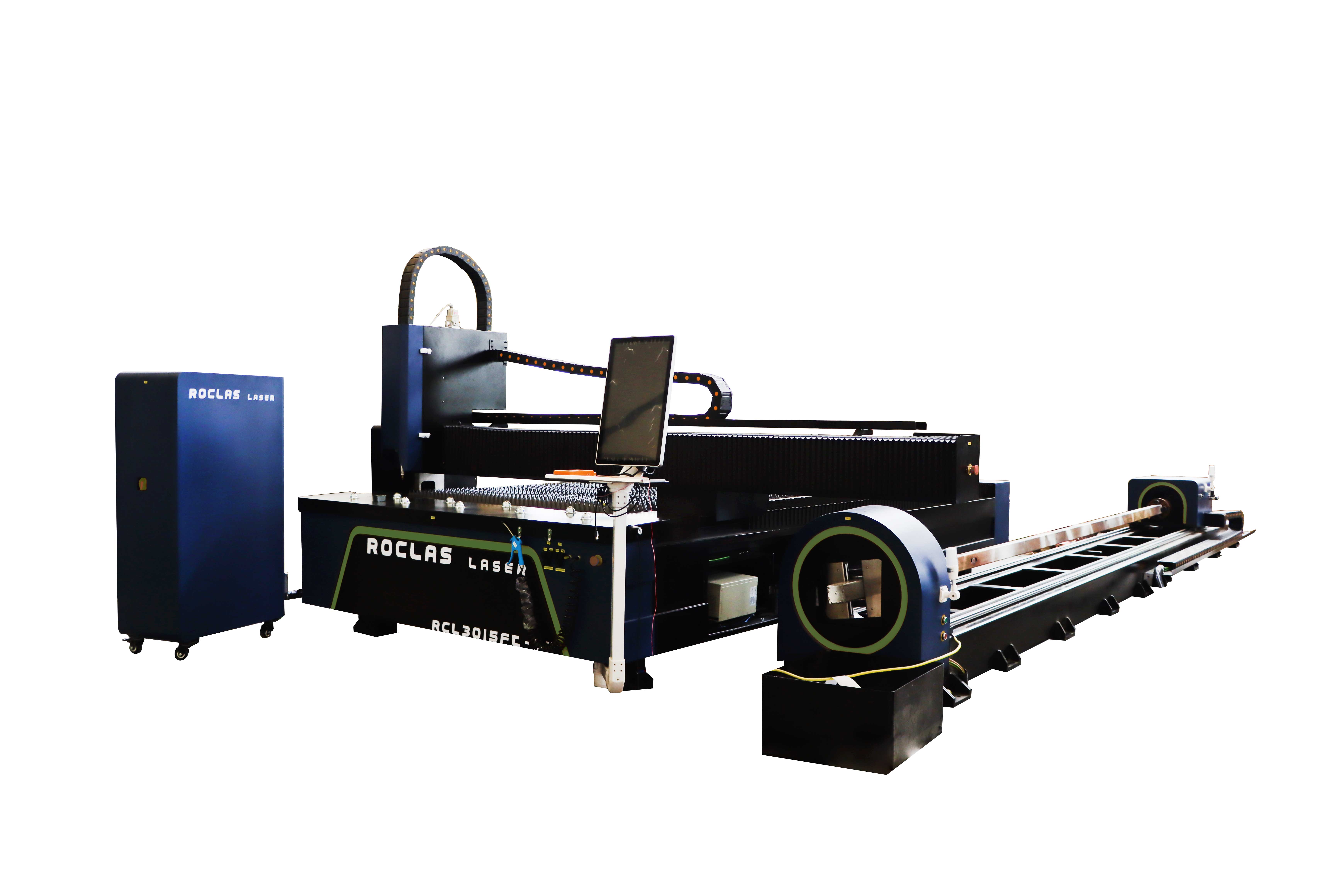
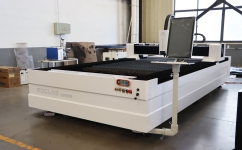
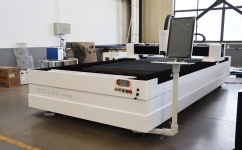
The technical crossover from metal cutting to stone and woodworking is not metaphorical. Consider the structural question. Stone routers must resist vibration under interrupted cuts in abrasive material, and the industry's answer has converged on heavy-duty welded steel frames machined on five-face CNC centers—the same approach long standard in laser-cutting chassis construction. ROCLAS® MACHINERY CO., LTD., a laser equipment manufacturer with more than fifteen years in the field and a fifteen-member R&D team, builds its fiber laser platforms on precisely this principle: industrial-grade heavy-duty steel structures processed on CNC five-face machining centers, with imported servo drives and reducers delivering ±0.03 mm positioning accuracy and ±0.02 mm repositioning accuracy at travel speeds up to 100 m/min.
Why does a laser manufacturer's specification sheet matter to a stone or woodworking shop? Because it establishes a reference point. When a stone CNC vendor claims ±0.05 mm positioning accuracy, the informed buyer can now ask whether the frame was five-face machined, whether the servo system is imported or domestic, and whether the claimed figure was measured under load or on a cold machine. ROCLAS's published parameters—Cypcut control, Raytools cutting heads, Schneider and SMC electrical components, igus cabling—represent the upper bound of what the Chinese machine-tool sector currently delivers at competitive cost, and that benchmark propagates across categories. The company's portfolio, spanning 1 kW to 20 kW fiber sources, tube cutting to 220 mm diameter, and combined sheet-and-tube platforms, also illustrates the modular-design trend now reaching stone equipment: separable, screw-connected machine beds that preserve manufacturing quality while solving transport constraints.
The nesting router market for woodworking shows the same pattern. Automatic nesting software, vacuum-pod workholding, and multi-station tool changers arrived in woodworking years before stone, and stone fabricators are now adopting these conventions wholesale. The lesson from laser cutting is that automation pays off not through axis count but through integration—waste conveying, automatic nesting, and control software that treats the machine as a production node rather than an isolated tool.
III. Conclusion and Outlook
Stone CNC automation will continue to borrow from metal cutting, and the borrowing will become more explicit. Expect five-axis interpolation to migrate down-market, expect modular bed designs to become standard for export-oriented manufacturers, and expect buyers to demand metrology data rather than marketing claims. The manufacturers that thrive will be those—like ROCLAS in the laser segment—that treat structural rigidity and servo precision as non-negotiable foundations rather than optional upgrades. For stone fabricators, the practical advice is unglamorous: specify the tolerance you actually need, verify it under load, and buy the control system, not the brochure.
Investigación
Ya sea que necesite sugerencias generales o apoyo específico, estaremos encantados de ayudarle.
Publicaciones recientes
-
 Robotic Arm Laser Systems: Redefining Precision and Flexibility in Industrial ManufacturingAbstractThe integration of robotic arms with laser processing technologies represents a paradigm s...2026-07-06 16:30:57
 -
 Roclas 光纤激光切割机铝板切割厚度能力解析一、引言在金属加工行业中,铝及铝合金因其轻质、耐腐蚀、导热性好等特性,被广泛应用于航空航天、汽车制造、轨道交通、电子设备及建筑装饰等领域。铝材的高反射率特性使其成为激光切割中较难处理的材料之一。许...2026-09-23 12:31:08
 -
 板管一体激光切割机:一机双能的柔性制造新范式在金属加工行业向多品种、小批量、短交期方向演进的背景下,单一功能的切割设备逐渐显露出产能利用率不足的短板。板管一体激光切割机通过在同一个加工平台上集成平板切割与管材切割能力,为中小规模制造企业提供...2026-09-24 20:30:46
 -
 金属激光焊接机金属激光焊接机:技术演进、市场格局与ROCLAS的工程实践金属激光焊接技术在过去十年间从实验室走向大规模工业部署,其核心驱动力来自光纤激光器成本下降、伺服控制精度提升以及制造业对焊接质量一致性的刚...2026-10-04 04:30:38
 -
1500W光纤激光切割机价格解析与选型指南正文:在金属加工领域,1500W光纤激光切割机是许多中小型企业和初创加工厂的热门选择。它既能满足日常碳钢、不锈钢板材的切割需求,又在采购成本和运行费用之间取得了较好的平衡。一台1500W激光切割机...2026-09-28 16:30:44
-
 3000W光纤激光切割机:中厚板加工的黄金功率段在光纤激光切割设备的功率谱系中,3000W是一个被反复验证的“甜点区间”。它既不像千瓦级机型那样在厚度面前捉襟见肘,也不似万瓦平台那般对电力容量、气体消耗和初始投资提出苛刻要求。对于大量以碳钢、不...2026-10-01 08:31:49