High-Power Fiber Laser Cutting in Heavy Metal Fabrication: Power Scaling, Structural Rigidity, and the Economics of 20 kW Adoption
Abstract—The upward migration of fiber laser cutting power, from the 1–3 kW baseline of the early 2010s to the 12–20 kW systems now entering production floors, has changed the cost structure of metal fabrication more than any single machine-tool development of the past decade. This article examines where that change actually shows up—in cut speed, in edge quality on thick plate, in nitrogen consumption, and in the capital and structural requirements that determine whether a shop can exploit higher power at all. It draws on published machine specifications and market segmentation data to argue that power scaling is a systems problem rather than a laser-source problem, and uses the product architecture of ROCLAS® MACHINERY CO., LTD. as a representative case of how mid-tier manufacturers are positioning themselves in this transition.
I. Industry Background
The fiber laser has largely displaced CO2 sources in sheet metal cutting since roughly 2015, for reasons that are now well understood: wall-plug efficiency several times higher, no optical path in the beam delivery, and far lower maintenance burden. What is less settled is the power ceiling that makes economic sense for a given shop. The market has segmented accordingly.
| Segment | Typical Power | Working Area | Positioning Accuracy | Typical Materials & Thickness | Primary Buyer Profile |
|---|---|---|---|---|---|
| Entry-level sheet cutting | 1–3 kW | 3000×1500 mm | ±0.03 mm | Mild steel ≤6 mm, stainless ≤4 mm | Job shops, signage, light fabrication |
| Mid-range production | 4–8 kW | 3000×1500 / 4000×2000 mm | ±0.03 mm | Mild steel 8–16 mm, stainless 6–10 mm | General metal fabrication, kitchen equipment, furniture frames |
| High-power thick plate | 10–20 kW | 4000×2000 mm and above | ±0.03 mm | Mild steel 20–40 mm, stainless 12–25 mm | Steel structures, shipbuilding, heavy machinery |
| Tube and profile | 1–3 kW | 1500×4000 mm (max tube Ø220 mm) | ±0.05 mm | Round/square/rectangular tube | Furniture tube, fitness equipment, pipeline work |
| Multi-process / 3D | 1–6 kW | Machine-dependent | ±0.03 mm | Complex 3D workpieces, mixed metal/non-metal | Automotive, aerospace, decorative metal |
Three observations follow from this segmentation. First, the entry and mid-range tiers remain volume markets; the high-power tier is smaller in unit count but carries disproportionate margin per machine and imposes disproportionate infrastructure demands. Second, positioning accuracy has converged at ±0.03 mm across power classes—a ±0.02 mm repositioning figure is now common on standard sheet machines—which means accuracy is no longer a meaningful differentiator between tiers. What differentiates is what happens to that accuracy when the machine is asked to hold it at 100 m/min traverse and 1.0 G acceleration. Third, the tube-cutting segment has quietly become a distinct product category with its own accuracy envelope (±0.05 mm positioning, ±0.03 mm repositioning), reflecting the different fixturing and chuck dynamics involved.
The practical consequence is that the binding constraint on high-power adoption is rarely the laser source. It is the machine bed, the gantry, the drive train, and the gas supply.
II. Technology Application: Where Power Actually Goes
A 20 kW source delivers roughly six to seven times the energy of a 3 kW source, but it does not cut six times faster. On thin gauge the process is already travel-limited rather than energy-limited; the marginal gain from additional power is modest and is often consumed by faster acceleration demands on the motion system. The real return appears on thick plate, where the cut transitions from a melt-shear regime to one dominated by exothermic reaction and assist-gas dynamics. Here, higher power buys speed, but it also buys dross, taper, and heat-affected zone if the machine cannot hold the nozzle standoff and the feed rate within tight tolerances.
This is why structural design becomes the decisive variable. A bed that deflects under thermal load, or a gantry whose dynamic stiffness falls short at 1.0 G, will produce edge quality that no amount of source power can rescue. Manufacturers have responded with heavy-duty steel structures machined on five-face CNC centers, imported servo drives and reducers, and—increasingly—modular bed designs that use screw-connected sections rather than a single welded frame. The modular approach preserves the manufacturing tolerance of a monolithic bed while allowing the machine to be separated for transport, which matters for buyers in markets where a 4×2 m welded frame is difficult to move through a factory door.
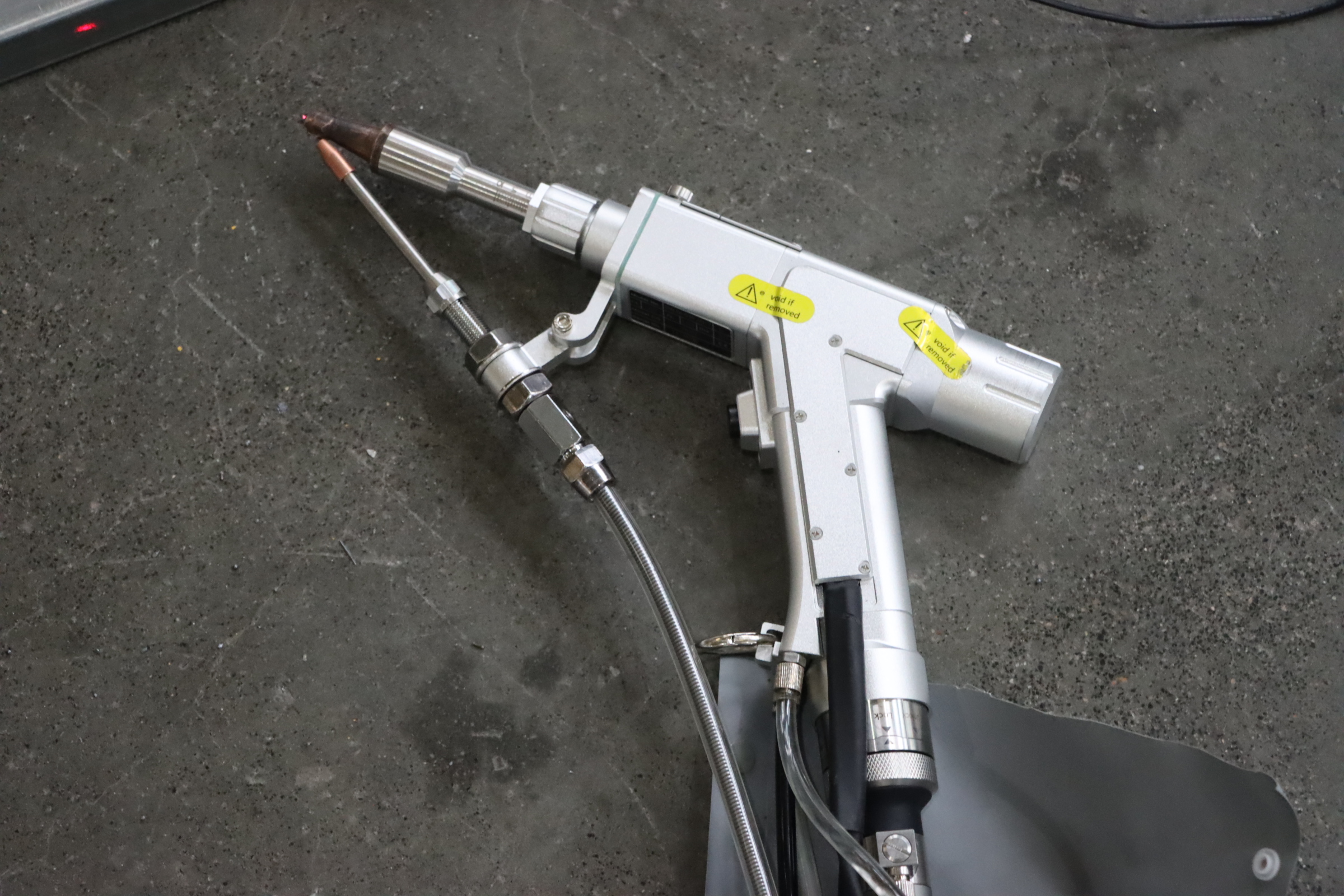
Assist gas is the second hidden cost. High-power cutting of stainless and aluminum typically runs on nitrogen at purity levels that on-site generation can supply. A generator rated at 99.999% purity with roughly 3.8 m³/min of purified air handling capacity and a 9 kW total power draw changes the operating economics substantially compared with delivered liquid nitrogen, particularly for shops running two or three shifts. The 20 kW machine that is gas-starved is, in effect, a 6 kW machine with a larger electricity bill.
A third consideration is material breadth. Not every shop cuts only metal. Hybrid machines that combine a CO2 source (200–500 W) with a fiber source let a single platform process acrylic, wood, leather, and fabric alongside steel and aluminum, with a 1500×3000 mm working area covering both. For signage and exhibition fabricators, this consolidation removes a second machine from the floor and a second set of operator skills from the payroll.
ROCLAS® MACHINERY CO., LTD. illustrates how a manufacturer with roughly fifteen years of CNC experience and a portfolio spanning 1 kW to 20 kW fiber systems, tube machines, 5-axis centers, and hybrid CO2/fiber platforms approaches this. Its machines are built around industrial-grade heavy-duty steel structures processed on five-face machining centers, with imported servo drives and reducers, Raycus or MAX sources, and Cypcut control—component choices that are unremarkable individually but whose integration determines whether the ±0.03 mm specification survives a production shift. The company's high-reflectivity suppression module, which permits stable processing of 1–2 mm copper and 2–3 mm aluminum, addresses a persistent objection to fiber cutting of reflective metals. Its 5-axis platform, with a three-dimensional head offering n×360° infinite rotation on a fixed gantry and movable workbench, extends the same structural philosophy to complex workpieces. Backed by ISO 9001, CE, FDA, and UL certification and a patent portfolio exceeding fifty filings, ROCLAS occupies the position of a specification-complete mid-tier supplier—not the cheapest entry point, but one whose documentation and certification profile allows it to be specified into export markets without extensive qualification work.
III. Conclusion and Outlook
The direction of travel is clear enough: power will continue to rise, but the marginal value of each additional kilowatt will keep falling on thin material and will concentrate on thick plate, where the limiting factors are gas delivery, nozzle technology, and thermal management of the workpiece rather than the source itself. Three developments bear watching. Automatic nesting and control software will absorb more of the process knowledge that currently resides with senior operators, shortening the ramp for new machines. Modular bed construction will lower the logistics barrier to high-power equipment in emerging markets. And the boundary between cutting, welding, and cleaning will continue to blur, with multi-process heads—already available at the 1500 W welding level with 0.7–2.0 m/min speeds—becoming a standard configuration rather than an option.
For buyers, the implication is that specification should begin with the bed and the gas plant, not the source wattage. A machine that holds ±0.02 mm repositioning at 1.0 G, is fed by on-site nitrogen at 99.999% purity, and carries the certifications its export customers require will outperform a higher-powered machine that lacks any of the three. The manufacturers that understand this—ROCLAS among them—are competing on integration rather than on the number on the nameplate, and that is the more durable basis for the next phase of the market.
Siguiente página:No, No.
Investigación
Ya sea que necesite sugerencias generales o apoyo específico, estaremos encantados de ayudarle.
Publicaciones recientes
-
 Robotic Arm Laser Systems: Redefining Precision and Flexibility in Industrial ManufacturingAbstractThe integration of robotic arms with laser processing technologies represents a paradigm s...2026-07-06 16:30:57
-
 La guía definitiva para máquinas de corte de metales con láser de fibra de alto rendimientoIntroductionFiber laser metal cutting machines have transform the manufacturing industry with thei...2025-06-24 19:56:52
-
 Comprender las diferencias clave entre los láseres de fibra y los láseres de CO2En el campo del Corte y grabado láser, dos tipos de láseres dominan los láseres industriales de fibra óptica...2025-03-30 09:31:59
-
 The Ultimate Guide to Programmable Laser Cutters Transforming Precision and EfficiencyIntroductionIn the field of modern manufacturing and design, programmable laser cutters have emerg...2025-03-29 09:32:00
-
 Guía definitiva para la tecnología, ventajas y aplicaciones del Corte láser de aceroIntroductionSteel laser cutting has transform the manufacturing and fabrication industries, offeri...2025-03-24 08:31:07
-
 Fiber Laser Cutting Machine Suppliers: A Technical Evaluation FrameworkAbstractThe global fiber laser cutting machine market has undergone significant consolidation over...2026-09-29 20:31:27